
30 October 2025, Brussels – Addressing the urgent need to reduce greenhouse gas emissions, the EU-funded project ECO2Fuel has made a significant advancement. They have successfully demonstrated a closed carbon loop system that combines power generation using synthetic fuel, CO2 capture and recycling, and heat reuse. This innovative approach addresses the critical need for sustainable energy solutions.
Carbon is a fundamental element that not only forms the basis of life but also plays a crucial role in the modern world, driving many technological advancements. It is present in a wide range of products and technologies, from the petrol that powers our cars to the cushioning in our running shoes, the electronics we use daily, construction materials, and components of electric vehicles.
Project Coordinator, Faria Huq, Deutsches Zentrum für Luft- und Raumfahrt e.V. – DLR:
„The carbon-capture technology developed with ECO2Fuel converts CO2 to sustainable synthetic gaseous and liquid e-fuels, without relying on hydrogen or critical raw materials (CRM). These e-fuels can serve as starting material for synthetic aviation and transport fuels, while the renewable energy during electrochemical CO2 conversion can be used for different applications, for example, for backup power generation. By integrating CO2 capture and waste-energy reuse, we are closing the carbon loop and advancing Europe’s transition toward a circular energy system and lowering our dependency on fossil fuel-based systems for energy. Our target of achieving a system CAPEX of 400–600 €/kW will enable cost-competitive e-fuel production, supporting the EU’s Green Deal, Net-Zero Industry Act, and Renewable Energy Directive goals”.
Removing up to 99% CO2 from the exhaust gases
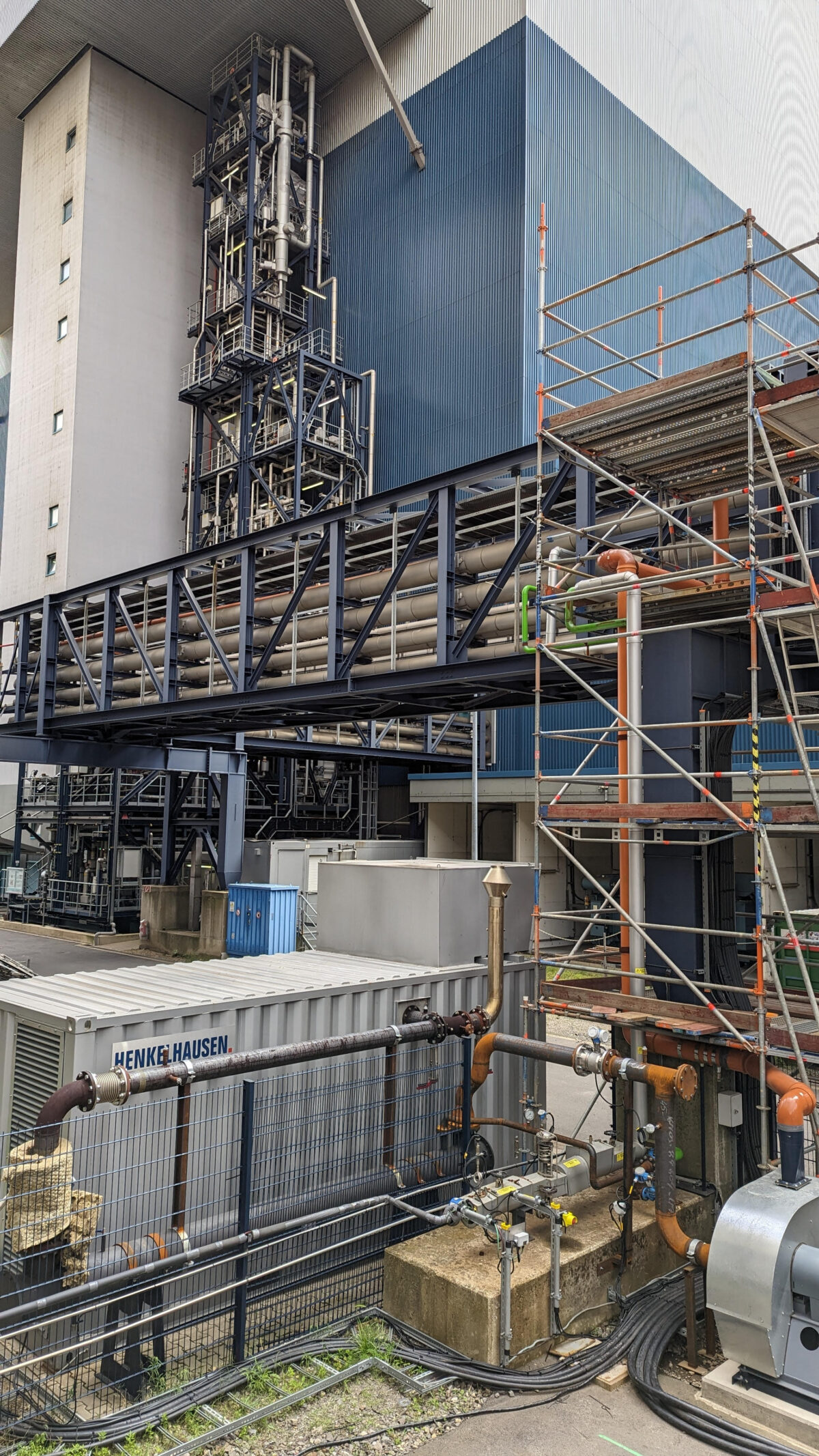
In this regard, ECO2Fuel’s partner RWE Power, which oversees site-demonstration testing, has successfully demonstrated a new method of generating back-up power using environmentally friendly synthetic fuels, which will be produced electrochemically by the ECO2Fuel process that is currently being tested on a pilot scale at ECO2Fuel’s partner VITO. RWE used a stationary diesel genset with an electric output of 200 kW for this purpose. The exhaust gases produced by this engine are sent back to a carbon capture pilot plant, which uses a chemical process with amines (compounds often used to remove CO2) to capture carbon dioxide. This pilot plant at RWE’s Innovation Centre at Niederaussem captures 7.2 tonnes of CO2 per day from the exhaust gases, at a capture rate of 90% or higher. During a testing campaign, capture rates of >99.8% were achieved, at times resulting in a lower CO2 concentration in the off-gas from the carbon capture plant than in the atmosphere.
To close the carbon cycle, the captured CO2 can again be used as a raw material for the ECO2Fuel demonstrator, which will have a capacity of 1 MW and produce carbon-based e-fuels. These e- fuels can be further processed and reused in the engine, creating a cycle that recycles the carbon rather than releasing it into the atmosphere, thus “closing the carbon loop”. In each cycle, fossil carbon is replaced by recycled carbon and emissions from fossil feedstock are avoided. Additionally, the high-temperature exhaust gas from the engine is being studied for its potential to be reused for heating and improving overall energy efficiency.

In a de-fossilised energy and power supply, peak and backup power will largely be provided by batteries, which have a far better round-trip efficiency. However, batteries have a limited capacity and are not designed to run for weeks in dark, foggy winter times when solar and wind power are not available.
The ECO2Fuel technology can produce the educts for Fischer–Tropsch fuels, such as sustainable aviation fuels (or synthetic kerosene), with synthetic diesel fuel as a by-product.
“The closed carbon cycle was never intended to be a stand-alone process for peak and backup power generation, but it is an attractive add-on to e-fuel applications, although these will be mainly used in transportation sectors, such as marine and aviation, and as a feedstock for certain products in the chemical industry,” explains Knut Stahl, RWE Power’s project manager for ECO2Fuel. E-fuels can be produced where renewable power is abundant, easily transported, stored in large quantities for a long time, and used when there is a severe power shortage.
“When a blackout looms, power suppliers will do anything to keep the lights on, no matter the efficiency of the power source. In the ECO2Fuel project, we have successfully demonstrated that synthetic fuels can be used for peak and backup power generation, even if they were not produced for this purpose”.
In a de-fossilised world, carbon will become scarce, and captured CO2 may become a valuable carbon source. Closing the carbon cycle by converting CO2 and renewable power into carbonaceous fuels and back to electrical power, as demonstrated in ECO2Fuel, allows to use of carbon multiple times and replaces fossil carbon. “The overall goal is to convert green electrons into green molecules, coupling the sectors’ energy, transportation and industry”, adds Dr. Peter Moser, head of RWE Power’s CCUS and Energy Storage research. “ECO2Fuel is part of our long- term development of carbon capture, storage and utilisation solutions in the last two decades”.
The experts specifically looked at the effects of lower carbon dioxide and higher oxygen content in the exhaust gas and at increased nitrogen oxides (NOx) on the performance of the CO2 capture plant, including the energy needed to regenerate the solvent, emissions, and solvent degradation. This is important because these factors can significantly impact the efficiency, cost, and environmental footprint of CO2 capture technologies, ultimately affecting their feasibility for large-scale implementation in industrial settings. The testing campaigns were carried out by RWE Power using its operational infrastructure and staff at the Innovation Centre at Niederaussem (North Rhine-Westphalia, Germany).
The advancement presented by ECO2Fuel’s partners lies in the successful integration and demonstration of a closed carbon loop system. This combines e-fuel combustion, CO2 capture and recycling, and heat reuse, contributing to the broader goal of achieving net-zero emissions in the energy, transport, and industrial sectors.
Read the scientific paper: Closing the Carbon Cycle – Demonstrating Back-Up Power Production from E-Fuels in Gensets and Recycling of the Engine Exhaust Gas, Peter Moser, Knut Stahl, Georg Wiechers. Available here: https://papers.ssrn.com/sol3/papers.cfm?abstract_id=5016150
Building a low-carbon, climate-resilient Europe
This demonstration is a huge milestone in the journey of ECO2Fuel, a European initiative aiming at creating the world’s first 1 MW low-temperature electrochemical CO2 conversion system. In ECO2Fuel, 15 international partners from the chemical, energy, hydrogen, mechanical engineering and automotive industry, and several research institutions are working together to build a low-carbon, climate-resilient future by converting 742 tonnes of CO2 per year into economic and sustainable liquid e-fuels and chemicals.

ECO2Fuel site. Source: ECO2Fuel
ECO2Fuel is setting a new standard for sustainable energy solutions by demonstrating how carbon can be recycled and reused rather than emitted into the atmosphere. This advancement in the project showcases a closed carbon loop system, proving that it’s possible to use e-fuels and CO2 capture technology to reduce emissions significant.